
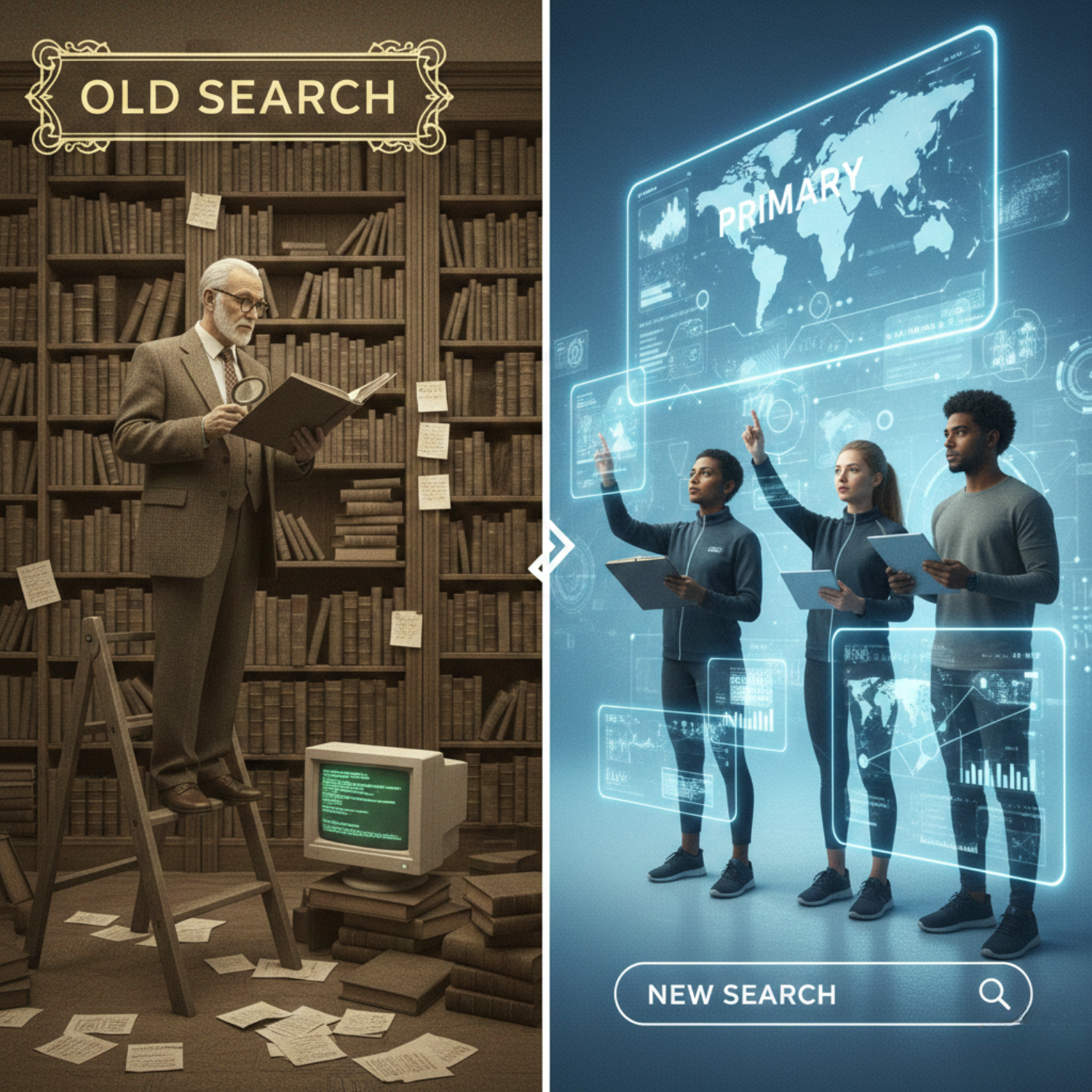
Someone out there is asking ChatGPT to recommend a business like yours right now. And your name? Probably not coming up. That’s not because you’re doing a bad job. It’s because your online presence was designed for a version of search that’s losing ground fast. GEO, AEO, new acronyms, real consequences. We’ll walk through what’s actually happening, throw some numbers at you, and give you practical steps to stop being invisible to AI.
People Aren’t Just “Googling” Anymore
Here’s a question. When was the last time you scrolled — really scrolled — through a full page of Google results? Past the ads, past the first three organic links, all the way down?
Yeah. Most people can’t remember either.
But try this one: how many times this week did you type something into ChatGPT? Or ask an AI to recommend something for you? That number’s probably higher than you’d like to admit.
We’ve been watching this shift happen in real time at Salty Lavender, and it still catches us off guard sometimes how fast it’s moving.
Gartner said back in early 2024 that traditional search would lose 25% of its volume by 2026 because of AI chatbots. People thought that was dramatic. Two years later? It looks like they might have been playing it safe.
The numbers are genuinely wild. ChatGPT — 800 million weekly users. 2.5 billion prompts going through it daily. And Perplexity? That thing barely existed two years ago and now it processes 780 million queries a month. A year before that it was 230 million. We’re not talking steady growth here. We’re talking about a hockey stick graph that keeps getting steeper.
Oh, and Google? Google’s also moving away from traditional search results. Kind of ironic, right? We’ll get to that.
If your whole strategy is “rank on Google,” you’ve got a blind spot the size of a truck.
Google’s Own AI Is Stealing Your Website Traffic
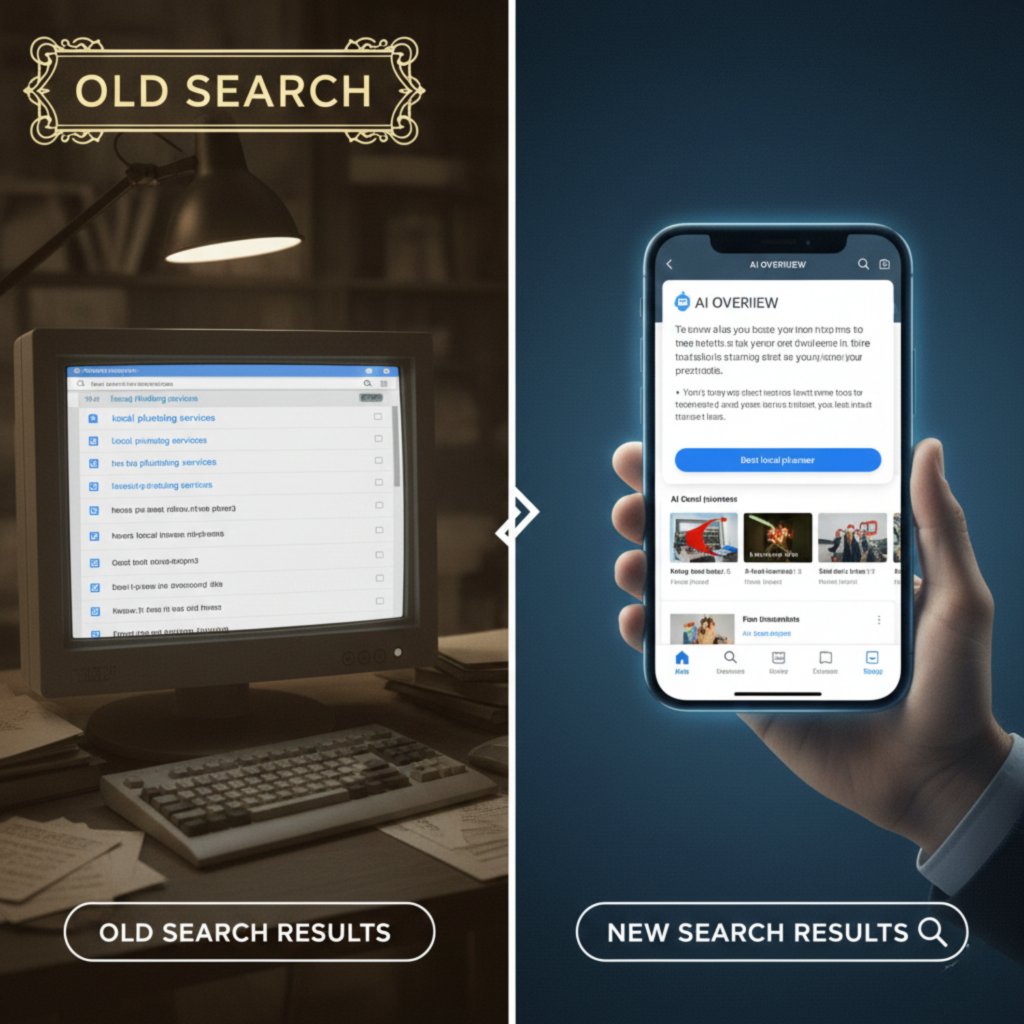
So you search for something on Google. But instead of the links you’re used to, there’s this big chunky AI-written summary parked at the very top. That’s Google’s AI Overview feature. Powered by Gemini, their AI model.
Google built a feature that answers people’s questions so well that they don’t need to click on anyone’s website anymore. Including yours. Think about that for a second.
How widespread is this? Semrush tracked it and found AI Overviews showing up in roughly 25% of searches by mid-2025. And the click damage is brutal — 58% fewer clicks when one of these summaries appears, according to Ahrefs data from February 2026.
But here’s the number that really made us sit up straight. Similarweb found that 83% of searches with an AI Overview end with zero clicks. Zero. Nobody clicks anything. They read the summary, they get their answer, they close the tab.
We started bringing this up with clients a few months ago. The reaction is always some version of: “Wait. People don’t even click anymore? Then what’s the point of my website?”
Which, honestly, is the right question to ask. Because the answer isn’t “there’s no point.” The answer is: the point has changed. You used to need people to click on your link. Now you need to be the source that AI cites in its answer. Totally different objective.
GEO. Another Acronym. But This One Matters.
GEO stands for Generative Engine Optimisation and yes, we know, another acronym. Marketing loves them. Sorry about that.
But this one you actually need to pay attention to.
We’ve been doing SEO work for clients for a long time now. We know the playbook. Keywords, backlinks, technical audits, content strategy. It works. Still works. Not going anywhere.
GEO is a different animal though. Where SEO is about convincing Google’s algorithm that your page deserves to rank, GEO is about making your content the kind of thing that ChatGPT, Perplexity, or Google’s own AI reaches for when it needs a source to cite.
Picture it like this. SEO is getting your restaurant listed on a “best restaurants” page. GEO is getting the food critic to actually quote you in their review.
And here’s what messes with people’s heads. Position Digital pulled together data showing only 12% of the URLs that AI platforms cite also show up in Google’s top 10 results. Twelve percent! You could be number one on Google for your main keyword and ChatGPT might not reference you at all. We’ve seen it happen. It’s frustrating and it’s real.
AEO Is the One Nobody’s Talking About Enough
This one flies under the radar and we think that’s a mistake.
AEO. Answer Engine Optimisation. It’s the strategy behind getting your content into those Featured Snippet boxes on Google — the ones that show a direct answer before any regular results appear. Also covers voice search. When someone asks Alexa a question and gets a single answer read back to them, AEO is what got that answer selected.
Neil Patel breaks it down well on his blog — AEO shines with specific, punchy questions where people want one clear answer. “What’s the capital of Portugal?” type stuff (obviously your business content is more complex than that, but the principle holds). GEO is more about the meaty research questions where AI has to pull from multiple sources.
Our position on all of this? Treat them as three legs of one stool. SEO handles the traditional search game. AEO captures those prime answer spots. GEO covers the AI citation world. Knock one leg out and the whole thing wobbles. We’ve tested this with our own clients and the difference between two-out-of-three and all-three is bigger than you’d expect.
OK Enough Concepts. What Should I Actually Be Doing?
We asked ourselves this same question when we started seeing these shifts. Here’s what we’ve landed on after months of testing and watching what works.
Your Content Needs to Be Worth Stealing
That sounds provocative but we mean it literally. AI platforms “steal” from the best sources on the web (whether that’s ethical is a whole other debate). The question is: is your content good enough to steal?
Most websites we audit? No. They’re full of stuff like “We provide innovative solutions tailored to your unique business needs.” Nobody’s citing that. Not a human journalist, not ChatGPT, not anyone. There’s nothing there to cite.
Superlines published some interesting research on what ChatGPT actually tends to cite. Content that stakes out a clear position. Content with real data attached. Content where someone with a name and credentials wrote something specific.
One of our clients switched from generic service descriptions to detailed case breakdowns with actual numbers — “email segmentation pushed their open rate from 12% to 34% in six months” — and saw a noticeable uptick in AI mentions within a few months. Anecdotal? Sure. But it tracks with what the research says.
People Need to Know Who Wrote This
We’ve been hearing about Google’s E-E-A-T thing (Experience, Expertise, Authoritativeness, Trustworthiness) for ages now and at some point it all starts to blur together. But here’s why it matters again, freshly: AI platforms care about this stuff too.
The pattern we keep seeing with our clients is pretty clear. Content with a named author who has a real bio? Performs better. Content by “Admin” with no photo, no credentials, no LinkedIn? Increasingly invisible. Not just on Google. Everywhere.
If you think about it from the AI’s perspective — and yeah, we know AI doesn’t technically have a “perspective,” but go with it — wouldn’t you also lean toward the source where an actual expert put their name to it? Of course you would.
Mirror How People Actually Search Now
A friend of ours made a good point recently. She said: “I don’t search anymore. I ask.” And she’s right. The entire vocabulary of search has changed.
People don’t type fragmented keywords into ChatGPT. They write full sentences. “What should I look for when hiring a marketing agency in Portugal?” is a real query. “How do I know if my business actually needs a social media manager?” is another one.
Your content should use those questions as headings, then drop a tight answer (40-ish to 60-ish words) right below. Go into detail after that. This particular format is a workhorse — Featured Snippets pull from it, voice assistants read the short answer, AI platforms grab it as a reference chunk. We didn’t invent this approach, but we use it constantly because it keeps delivering.
For the Love of Everything, Don’t Drop Your SEO
The “SEO is dead” crowd has been loud lately and we think they’re wrong. Not slightly wrong. Substantially wrong.
Why? Because Ahrefs’ data shows 76.1% of URLs in Google’s AI Overviews also rank in the traditional top 10. Your SEO work is feeding your AI visibility whether you realize it or not. They’re connected. Deeply connected.
Walk away from SEO now and you lose ground on both fronts simultaneously. That’s not a strategic pivot. That’s shooting yourself in both feet at once.
The Boring Technical Stuff Is Suddenly Exciting
We never thought we’d say this, but page speed has become one of the most interesting conversations in marketing right now.
Superlines found that pages loading in under 0.4 seconds were three times more likely to be cited by ChatGPT’s research tools. Three times! All because the page loaded fast.
So yeah. Schema markup, FAQ structured data, clean heading hierarchies, mobile performance — all that stuff your developer told you was important three years ago and you maybe didn’t prioritise? It’s urgent now. If your site crawls along at four seconds on mobile, that’s no longer just annoying for visitors. It’s actively keeping AI from citing you.
This Isn’t Slowing Down
We’ll give it to you straight. Two billion people a month use Google’s AI Overviews. ChatGPT does 5.7 billion monthly visits. Zero-click searches went from 56% to 69% in a single year according to Similarweb data compiled by XICTRON.
Thirteen points in twelve months. That trend line isn’t bending.
The businesses adjusting right now? They’re going to keep showing up. The rest will stare at shrinking traffic numbers and wonder what happened, convinced they did everything by the book. And technically they did. Just the wrong book.
We Can Help With This
SEO was already a full-time job before AI showed up and complicated everything. We know. We do this for a living.
At Salty Lavender, this shift has been front and centre for us over the past year. We’ve been adjusting client strategies, testing what works, and watching the results. Some of what we expected to work didn’t. Some things we weren’t sure about turned out to be game-changers. That’s the nature of it right now — the playbook is still being written.
If you want to know where your business stands in all of this — traditional search, AI visibility, the whole picture — reach out. We’ll give you an honest assessment and go from there. No sales pitch dressed up as a consultation. Just a conversation about what’s actually going on with your online presence.
Frequently Asked Questions
What is GEO in digital marketing?
It’s the weird new cousin of SEO that nobody asked for but everyone needs to deal with. GEO (Generative Engine Optimisation) is about getting your content picked up by AI platforms when they generate answers. So when someone asks ChatGPT something about your industry and it pulls together a response, GEO is what determines whether your business makes it into that response or gets left out completely.
Is SEO dead in 2026?
No. Full stop. The data doesn’t support that conclusion at all — more than three out of four URLs showing up in Google’s AI Overviews also rank well in traditional search. What’s true is that SEO by itself isn’t the whole picture anymore. You need the traditional search piece AND the AI piece AND the answer-engine piece. But “SEO is dead” makes for better LinkedIn headlines than “SEO needs to be part of a broader strategy,” so here we are.
How are SEO, AEO, and GEO different from each other?
SEO is the one you already know. Getting your website to rank on Google, Bing, whatever. Been around forever and still pulling its weight. AEO is more niche — it’s about landing in those Featured Snippet boxes and voice search answers where only one source gets picked. High stakes, small window. GEO is the newest. It’s about being the source AI platforms cite when they’re building their answers. The three overlap in a lot of ways. We think of them less as separate strategies and more like three angles of the same problem.
How can I get my business cited by ChatGPT or Perplexity?
Wish there was a shortcut. There isn’t. You need genuinely good content — specific claims, real numbers, named experts writing it. Your site has to load fast (under 0.4 seconds makes a real difference according to research we’ve seen). And the structure needs to be clean: logical headings, schema markup on key pages, content that an AI can actually make sense of quickly. None of it is glamorous. All of it compounds over time.
Should I worry about zero-click searches?
“Worry” is probably the wrong framing. Be strategic about them, though. Yes, fewer people click through to websites now. But if your brand is the one AI keeps citing in its answers, you’re building awareness and trust every time someone reads one of those summaries — even if they never visit your site. The goal used to be “get them to click.” Now it’s more like “be the name they keep seeing.” Different game. Still worth playing well.